Understanding Income Statements
Post on: 16 Март, 2015 No Comment
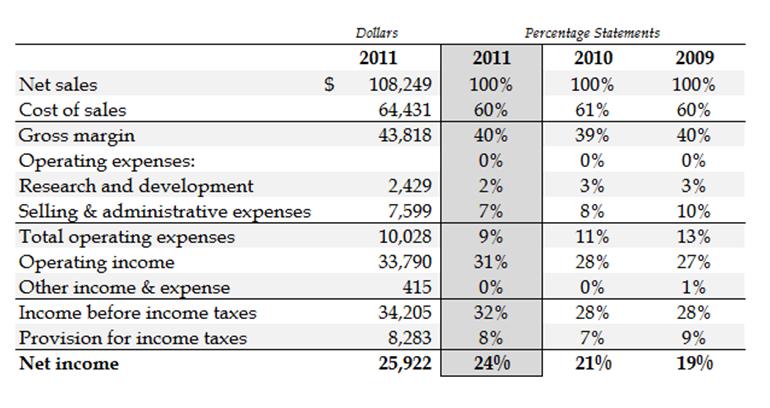
A guide for using fundamental analysis to understand income statements.
Smart investing usually begins with the right research and investing tools. Many investors turn to fundamental investment analysis to check the health of any company they’re considering for long-term investing. It often goes hand-in-hand with technical analysis, in which investors look for emerging patterns in price charts to determine new market trends.
Public companies issue many financial statements regularly, which can give you an inside view on what’s happening within the company — provided you know how to decode them. Here’s a primer that should help you understand a very common and useful document, the income statement.
The following screenshot is a real income statement for Caterpillar (NYSE:CAT) from 2003 — 2007. TradeKing clients can access this or any company’s income statement under Quotes + Research > Quotes + News + Research. First enter your ticker symbol, then click the Financials tab, then select Income Statement
The phrase the Bottom Line actually comes from income statements — CAT’s total profit or Net Income is the final line on this statement. Net Income gives you the bottom line state of this company’s health: is it making money (profitable) or not? During the period 2003 through 2007, CAT increased Net Income (thus its profitability) every year.
Let’s go back to the top and check out Net Sales or Revenues. That’s referred to as Top Line Revenues, and it provides handy answers to questions like: Are total revenues growing or shrinking? Without strong top-line revenue growth, it’s usually tough for any company to sustain earnings growth. Not surprisingly, CAT grew Top Line growth every year from 2003 through 2007, which helps to explain its Bottom Line growth.
The next two lines summarize the company’s costs to produce the products and services that they sold. Cost of Goods Sold measures direct cost of materials, labor, and the like. The Depreciation, Depletion & Amortization is an indirect cost associated with the declining value of certain assets.
Revenues of $44,958 million minus costs of $33,297 million leaves us with a Gross Income of $11,661 million. This number is important in itself and is part of a key ratio called Gross Margin, which measures what percentage of profit after costs is required to produce that revenue. Gross margins can vary widely by company, so it’s important to check any company’s gross margin with that of its main competitors. A higher gross margin from one competitor compared with another often means that it’s producing it goods more efficiently, or able to sell its goods at a higher price with lower relative costs.
The next few lines items are referred to as Operating Costs and represent costs other than those directly tied to producing the product. One item analysts watch closely is Selling, General & Administration Expenses; which refers to sales and administrative costs and measure how efficiently a company is selling its goods and managing its overhead.
Operating Income is calculated by removing these operating costs from total revenue and. is an important profit measure because it indicates the overall profitability of a company’s operations. It measures profitability before the impact of taxes, interest expense and other non-operational costs. Similar to its revenue and net income, CAT’s operating income grew every year from 2003 through 2007, indicating healthy operations. Analysts often look at Operating Income in the form of Operating Margin, which is operating income as a percent of revenue. Similar to gross margin, it’s important to compare operating margin of one company to its competitors to understand its overall performance relative to its peers.
TradeKing, a top-line stock and options broker
TradeKing is a nationally licensed online broker geared towards helping self-directed investors become smarter and more empowered. At TradeKing we offer the same fair and simple price to all our clients — just $4.95 per trade, plus 65 cents per option contract. You’ll trade at that price, no matter how often you trade, or how big or small your account may be. That’s what we call fair and simple.
In 2006 and 2007 SmartMoney Magazine named TradeKing the best discount online broker, and from 2008 through 2010 gave us the highest rating for excellent customer service. The SmartMoney broker survey ranks brokerages based on numerous criteria such as customer service, trading tools, research, commissions, interest rates, investment products, mutual funds, bonds and banking amenities.