The Revised Basel III
Post on: 16 Март, 2015 No Comment
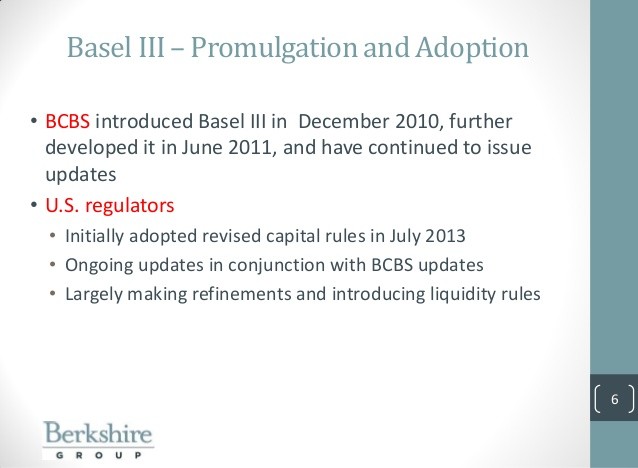
Basel III rules are designed to ensure that banks have sufficient cash buffer to weather a 30-day financial crisis. The regulations were to take effect from January 1 st. 2013 in 11 jurisdictions including major Asian entities like China, Japan, India, Hong Kong and Singapore.
On January 6 th 2013, Basel Committee on Banking Supervision softened the rules by an extension of the timeline for compliance and expansion of the asset classification. The Committee agreed to delay the full compliance of the new capital requirements until 2019 from the original 2015. The range of assets extends to include corporate debt with BBB- rating or higher and some mortgage-backed securities, replacing the original narrow “high quality” assets of cash, government securities and highly rated corporate bonds.
The revision of Basel III is a robust interaction between the financial regulators or lawmakers, and banks or more broadly, companies. I personally support this revision which is an active response from the lawmakers to the demand of companies. I will analyze the rationality from the reality and the theory perspectives.
Basel III rules cast huge pressure on all banks, from the world’s largest lender ICBC to small private banks in India. It tremendously reduces the liquidity and increases the funding costs, hindering the ability of banking system to finance a global recovery. ICBC plans to sell HK$74.12billion bonds to meet the requirement, worrying the public investors and hauling down the Shanghai Composite Index by 2% in intraday trading. The Reserve Bank of India deferred the implementation of Basel III by 3 months for banks to raise more capital. Ordinary consumers in Asia find it harder to obtain loans for cars and houses. These are the negative impact of the tough Basel III.
The regulators aim at controlling risks and preventing financial crisis, while they may also constrain banks from injecting liquidity in real economy. Banks, profit-oriented in nature, also possess more direct and local knowledge referred by F.A.Hayek than central regulators. The negotiation, fighting and concession between Basel Committee and banks gradually leads to the consensus of a revised and softened version of Basel III, a better balance between preventing banks from crisis and providing industries with enough liquidity.
The interaction in banking industry is a good example for others. A better consensus and solution may be reached through discussion, negotiation and concession, from both companies and lawmakers.
References:
www.dailyfinance.com/2013/01/14/3-banks-that-should-thank-regulators-for-revised-b/
www.scmp.com/business/banking-finance/article/1129748/icbc-fundraising-worries-investors
papers.ssrn.com/sol3/papers.cfm?abstract_id=2139380
www.hkma.gov.hk/eng/key-functions/banking-stability/basel-3.shtml
www.ibtimes.com/softening-basel-iii-capital-bank-rules-should-not-be-significant-997250